What Is the Purpose of Funeral Prayers?
Funeral prayers have several practical and religious purposes.
In a faith-based ceremony, prayers for the dead may commend the person into the care of God, ask for mercy, affirm beliefs about resurrection or rebirth, or remind the congregation of the principles of the faith. They can unite funeral attendees, particularly when everyone recites familiar words together.
Readings may explain the religious meaning of the ceremony and provide teachings about impermanence, eternity, service, compassion, or spiritual liberation.
In a secular service, readings can have a similar structural role without referring to a deity or religious doctrine. They can focus on the person’s character, relationships, achievements, interests, or positive influence on others.
When Are Funeral Prayers Recited?
- At the beginning of the service
- Before or after a eulogy
- During a period of reflection
- Before the committal
- At the graveside
- At a cremation ceremony
- At a later memorial gathering
- At an anniversary or remembrance event
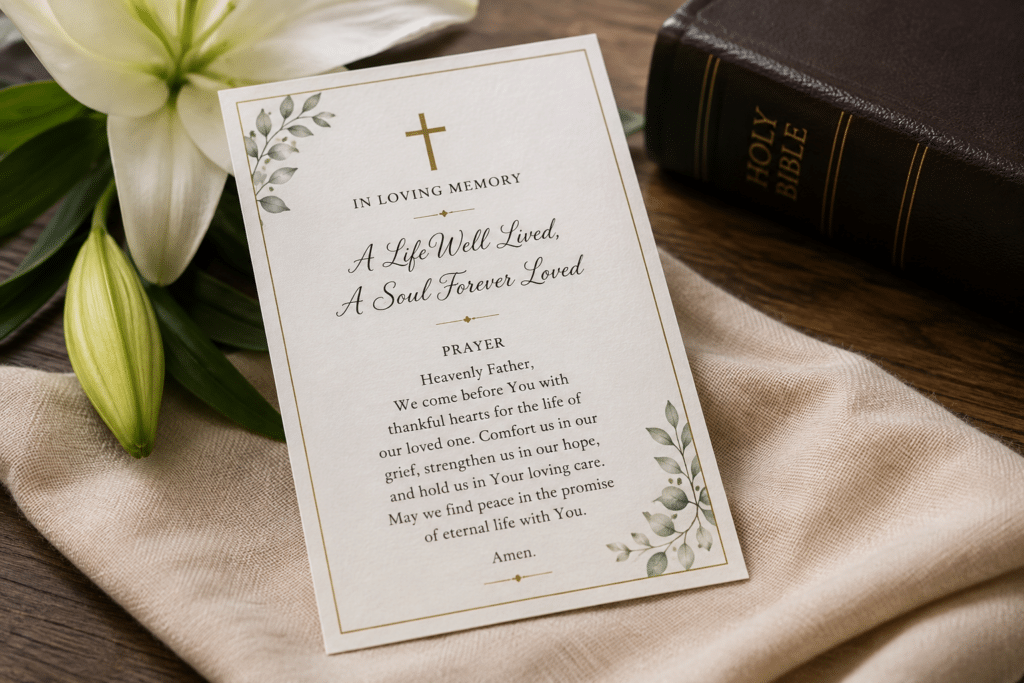
The appropriate time for a funeral prayer depends on the tradition and the type of ceremony being arranged. Prayers may be spoken aloud, included in the service program, or printed on a prayer card for guests to keep as a remembrance.
How to Choose Funeral Prayers and Readings
Before selecting a prayer or reading, it may be helpful to consider the beliefs and preferences of the loved one being remembered. A text might reflect their religion, worldview, or values. In addition to traditional prayers and scripture, families may choose funeral poems or other meaningful readings that reflect the loved one’s life and beliefs.
A few questions to ask when selecting prayers or readings may include the following:
- Did the person belong to a particular faith or denomination?
- Did they have a favorite passage, prayer, poem, hymn, or author?
- Were there religious customs they observed closely?
- Did they describe themselves as spiritual, agnostic, humanist, or non-religious?
- Did they hold any cultural traditions that may be important to represent?
You may also want to consider how the selected prayer or reading will be shared. For example, a meaningful passage might be read during the ceremony and included in the funeral program or printed on a funeral prayer card for guests to keep as a remembrance.
It may also be helpful to check whether the chosen tradition allows personal readings. Some ceremonies may follow a prescribed format and allow few changes, while others may provide specific points at which family members can speak.
Christian Funeral Prayers and Readings
A Christian funeral may vary considerably between Roman Catholic, Anglican, Orthodox, Baptist, Methodist, Pentecostal, evangelical, and other denominations. However, many Christian ceremonies may focus on God’s care, the resurrection, eternal life, forgiveness, and hope. A Catholic prayer may follow established liturgical traditions, while prayers in other denominations might allow more flexibility in their wording and placement within the service.
Christian Prayers at a Funeral
Common Christian funeral prayers may include:
- An opening prayer welcoming those gathered and asking for God’s comfort
- The Lord’s Prayer
- Prayers of thanksgiving for the person’s life
- Prayers asking for comfort and strength for grieving loved ones
- A prayer of commendation
- A prayer of committal
- A closing prayer or blessing offering comfort and hope
A short funeral prayer may also provide a meaningful moment of reflection during the service. Some Christian prayers may begin by addressing God as “Heavenly Father,” particularly when asking for comfort, strength, or peace during a time of grief.
Christian Readings at a Funeral
- Psalm 23 – “The Lord is my shepherd” is one of the most widely used Christian funeral texts. It describes God as a guide and protector and refers to walking through “the valley of the shadow.”
- John 14:1-6 – This passage includes the words, “In my Father’s house are many rooms.” It’s commonly selected because it refers to preparation, trust, and a place with God.
- Romans 8:31-39 – This reading states that nothing can separate believers from the love of God.
- Revelation 21:1-4 – This passage describes a renewed creation in which suffering and mourning are absent.
At a Roman Catholic funeral liturgy, the Catholic funeral prayers and scriptural readings are chosen from the Church’s approved biblical selections. Poems and other personal texts may sometimes be used at the vigil or another memorial gathering, but they don’t replace the biblical readings at Mass.
In Anglican and many Protestant services, you may have greater flexibility to choose readings, hymns, and contributors. Orthodox Christian services are generally more liturgical, with set prayers, chants, and scriptural passages.
Jewish Funeral Prayers and Readings
Jewish funeral prayers and practices vary between Orthodox, Conservative, Reform, Liberal, Reconstructionist, and secular Jewish communities. The service is simple and focused on honor, dignity, prayer, and accompaniment.
Jewish Prayers at a Funeral
The Mourner’s Kaddish
The Mourner’s Kaddish is one of the best-known Jewish prayers associated with mourning. It’s written primarily in Aramaic and praises God. It doesn’t directly describe the person being remembered. You may recite The Kaddish at the funeral and during the mourning period. In traditional communities, it may require a minyan, a quorum of ten Jewish adult men, but requirements vary by movement.
El Malei Rachamim
El Malei Rachamim, meaning “God full of compassion,” is a memorial prayer asking that the soul of the person be granted rest under divine protection. It’s usually recited at funerals and memorial observances.
Jewish Psalms and Other Readings at a Funeral
Psalms are often included, particularly:
- Psalm 23
- Psalm 91
- Psalm 121
- Psalm 130
A eulogy, known as a hesped, is meant to be truthful instead of exaggerated, honoring the life of a loved one while describing the person’s qualities, actions, family role, and contributions.
At the graveside, attendees may participate in placing earth into the grave. The service may also include the prayer known as Tzidduk HaDin, which acknowledges divine judgment.
Because Jewish customs can be specific, consider consulting a rabbi, the synagogue, or the chevra kadisha (holy society) arranging the funeral before adding poetry, music, or non-traditional material.
Islamic Funeral Prayers and Readings
Islamic funeral practices are guided by the Qur’an, the teachings of the Prophet Muhammad, and established community customs. The arrangements generally focus on simplicity, dignity, equality, and prompt burial.
Salat al-Janazah
Salat al-Janazah is performed while standing. Different from the five daily prayers, it does not include bowing or prostration. It consists of a sequence of declarations of “Allahu Akbar,” praise of God, blessings upon the Prophet, prayers for the person, and prayers for the Muslim community.
The wording may vary slightly between schools of Islamic law. The prayer is usually led by an imam or another knowledgeable member of the community.
Qur’anic Recitation
The formal Janazah prayer is distinct from a conventional reading-based memorial service. Qur’anic verses may be recited before or after the burial, depending on community practice.
Islamic Passages at a Funeral
- Surah Al-Fatihah
- Surah Al-Ikhlas
- Verses referring to return to God
- Verses about patience, accountability, and mercy
A commonly used phrase is:
“Inna lillahi wa inna ilayhi raji’un.” This means, “Indeed, we belong to God, and to Him we return.”
As accepted practices vary, consider speaking with the mosque or imam before introducing non-Qur’anic poetry, music, photographs, or personal tributes.
Hindu Funeral Prayers and Readings
Hindu funeral customs can change by region, language, caste, family tradition, and school of philosophy. Many Hindu beliefs include the continuity of the atman, or inner self, and the process of reincarnation and karma.
Cremation is common, although there are exceptions based on age, status, community, and local tradition.
Hindu Mantras and Prayers at a Funeral
The Maha Mrityunjaya Mantra, the ancient Sanskrit verse dedicated to Lord Shiva, may be chanted in some traditions as a prayer for liberation and spiritual protection.
Interpreted in several ways across Hindu traditions, the mantra “Om Shanti, Shanti, Shanti” can invoke peace at the physical, mental, and spiritual levels.
Some ceremonies include the repetition of a divine name, such as Rama, Krishna, Shiva, or another form of God associated with the family’s tradition.
A priest may guide you through rites before cremation, at the crematorium, and during subsequent observances. Later rituals may take place over several days and can include offerings, prayers, and acts that support the soul’s onward journey.
Ask the officiating priest which readings may be translated and whether relatives can contribute their own words.
Hindu Scriptures at a Funeral
Bhagavad Gita
Bhagavad Gita is one of the most frequently used texts. Relevant passages often include teachings that distinguish the eternal self from the physical body. A well-known section explains that the self is not created or destroyed and that it passes from one bodily state to another.
Other possible texts include:
- The Upanishads
- The Vedas
- The Ramayana
- The Garuda Purana
- Devotional hymns and mantras
- Regional-language prayers
Buddhist Funeral Prayers and Readings
Buddhist funeral traditions vary across Theravada, Mahayana, Vajrayana, Zen, Pure Land, Tibetan, Chinese, Japanese, Sri Lankan, Thai, Burmese, and other communities.
Common themes include impermanence, compassion, karma, rebirth, mindfulness, and freedom from attachment.
Buddhist Chants and Texts at a Funeral
The Metta Sutta
The Metta Sutta, particularly associated with Theravada traditions, focuses on loving-kindness and the wish that all beings be safe and at ease.
The Heart Sutra
The Heart Sutra presents the Mahayana teaching of emptiness and may be chanted in the traditional liturgical language or in translation.
Passages from the Dhammapada
Readings from the Dhammapada may address conduct, the mind, awareness, and the changing nature of all conditioned things.
Depending on the tradition, the ceremony may take place before cremation, during a wake, at a temple, or at scheduled intervals afterward. Some communities, particularly associated with Tibetan and several East Asian Buddhist traditions, place particular importance on the first 49 days.
Personal readings may be acceptable, especially in Western Buddhist services, but consider what fits the person’s practice and the guidance of the teacher or temple.
Sikh Funeral Prayers and Readings
A Sikh funeral is known as Antam Sanskar, which means the final rite. Sikh teachings focus on acceptance of Hukam, the divine order, remembrance of Waheguru, and the union of the soul with the divine.
Cremation is usual, although the central concern is not the method used but the spiritual understanding expressed through the ceremony.
Sikh Prayers and Hymns at a Funeral
- Singing or recitation of appropriate Gurbani
- Repetition of Waheguru, Kirtan Sohila, and Ardas
The Ardas may be offered before or after the cremation and may include asking for strength, acceptance, and remembrance of the divine name.
The service often takes place at a gurdwara, crematorium, family home, or a combination of locations. The Guru Granth Sahib, the central holy religious scripture of Sikhism, is treated with formal respect, and readings may form part of subsequent observances according to family and community practice.
You may include personal speeches. The focus is often on prayer, equality, service, and acceptance.
You can coordinate with the gurdwara committee, granthi, or another knowledgeable member of the Sikh community.
Secular and Humanist Memorial Readings
A secular funeral doesn’t follow a religious liturgy. It may be led by a humanist celebrant, civil celebrant, funeral director, friend, or family member.
However, the ceremony can still include non-religious funeral readings, periods of silence, music, and formal words of farewell.
Types of Secular Readings at a Funeral
- A favourite poem
- A passage from a novel
- A song lyric
- An excerpt from a philosophy book
- A letter written by the person
- A passage about nature
- A reading about memory, influence, or legacy
- An extract connected to the person’s profession or interests
Popular themes include the effect of a person’s actions, the cycles of nature, and the value of a life measured through connections and contributions.
A secular reading doesn’t have to avoid all spiritual language. Some people identify as non-religious while still appreciating ideas like interconnectedness or a return to nature.
Multi-Faith and Blended Funeral Services
Some families include members from several religious backgrounds. The loved one being remembered may also have drawn meaning from more than one tradition.
A multi-faith service can include selected readings from different sources, but consider careful planning. Combining traditions without context can create contradictions or the inappropriate use of sacred material.
Common Approaches for a Multi-Faith and Blended Funeral
- Identify the person’s primary beliefs
- Ask representatives of each faith what is appropriate
- Avoid presenting all religions as the same
- Allow attendees to participate according to their own conscience
- Use silence as a shared element
It may also be a good idea to have separate observances. For example, a formal religious funeral might be followed by another memorial gathering with personal readings and contributions.
Honoring Core Beliefs Through Funeral Prayers and Readings
When choosing a funeral prayer or reading, identify the tradition, level of observance, and nature of the ceremony. Then consult the officiant, faith leader, celebrant, or funeral director about the available choices.
A well-selected reading will have a clear purpose within the service. It may express a central belief, describe the person’s principles, or guide the congregation through a formal ritual.
In the end, the chosen prayers and readings should be accurate, respectful, understandable, and consistent with the loved one you are remembering.